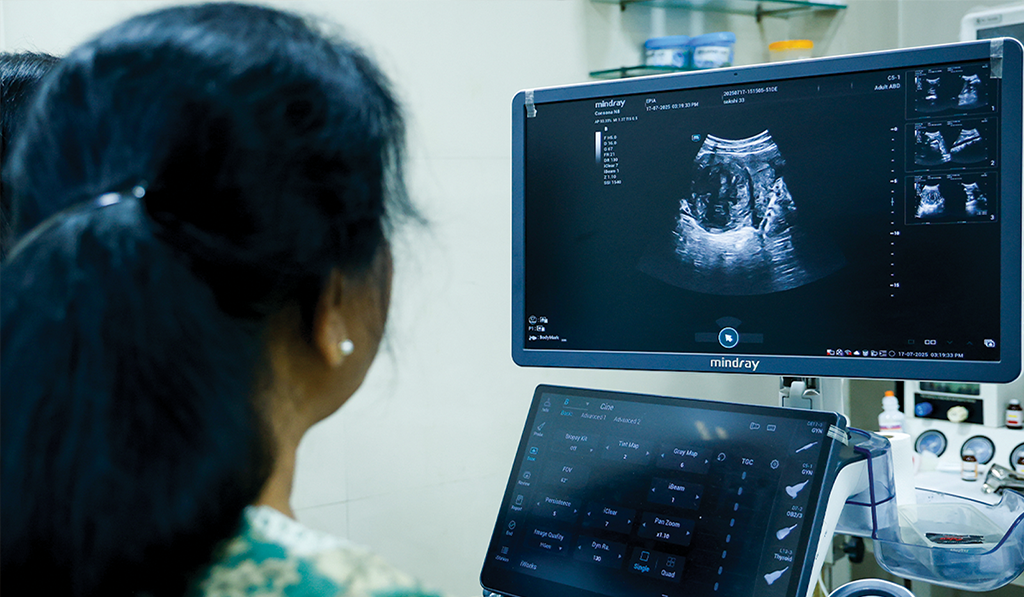
What Is a Pelvic Ultrasound?
A pelvic ultrasound is a non-invasive imaging technique used to examine the reproductive organs, including the uterus, ovaries, cervix, and bladder. It helps diagnose a wide range of conditions affecting menstrual health, fertility, and pelvic pain. There are two types of pelvic ultrasound: transabdominal (done over the abdomen) and transvaginal (using a slender probe inserted into the vagina for closer imaging).
At EPIA, pelvic ultrasound plays a central role in fertility evaluations, cycle monitoring, and routine gynaecological care. It provides real-time, detailed insights without radiation exposure—making it safe for both diagnostic and treatment-related use.
Why Choose EPIA for Pelvic Ultrasound?
At EPIA, your pelvic ultrasound is not just a scan—it’s a key piece of your fertility or gynaecological puzzle. Our imaging is done by experienced sonographers and interpreted by specialists who understand how every detail matters, especially in complex or delicate cases.
What sets us apart:
- Same-cycle reporting and follow-up
- High-resolution transvaginal probes for clearer assessment
- Integrated ultrasound in fertility planning and treatment monitoring
- Compassionate, comfortable care for first-time patients
- All scans reviewed directly by fertility or gynaecology experts
Whether you’re here for a basic check-up, cycle tracking, or diagnostic investigation, you’ll receive attentive care and clear explanations throughout.
What’s Included in Pelvic Ultrasound at EPIA?
- Uterine Assessment: Checking for fibroids, polyps, lining thickness, or congenital anomalies
- Ovarian Evaluation: Counting antral follicles, identifying cysts or PCOS patterns
- Cycle Monitoring: Tracking follicular growth, ovulation timing, and corpus luteum development
- Endometrial Check: Measuring thickness and pattern, especially important for IVF or IUI planning
- Bladder & Adjacent Structures: Ruling out fluid buildup, masses, or unusual anatomy
- 3D/4D Imaging Options: Available where deeper mapping or anatomical detail is needed
Your scan may be scheduled based on your cycle phase to optimise clarity and diagnostic accuracy.
Who Should Consider a Pelvic Ultrasound?
- Anyone trying to conceive or undergoing fertility treatment
- Individuals with irregular periods or suspected PCOS
- Patients experiencing pelvic pain, bloating, or abnormal bleeding
- Women with a history of fibroids, cysts, or endometriosis
- Those preparing for embryo transfer or egg retrieval
- Anyone seeking a routine reproductive health check-up
If you’ve never had a transvaginal ultrasound before, our team will explain the process and make you feel at ease.
Pelvic Ultrasound FAQs
What’s the difference between abdominal and transvaginal ultrasound?
Abdominal scans are done over the belly and provide a general view. Transvaginal scans use a slim probe for closer, more detailed imaging of the uterus and ovaries.
Is it painful?
Abdominal scans are painless. Transvaginal scans may feel slightly uncomfortable but are usually quick and well tolerated. We ensure your comfort throughout.
Do I need to prepare before the scan?
For abdominal scans, a full bladder is typically required. For transvaginal scans, no special preparation is needed, and an empty bladder is often preferred.
When in the cycle should this be done?
It depends on your reason for the scan. Fertility-related ultrasounds are often done between Day 2 and Day 5 of the menstrual cycle or mid-cycle for ovulation tracking.
Can I have this scan during my period?
Yes, although it may be less clear for certain assessments. If you’re unsure, our team will help you time your scan appropriately.
Are ultrasound scans safe?
Absolutely. Pelvic ultrasound uses sound waves—not radiation—and is safe for repeated use, including during pregnancy.