What is Assisted Hatching?
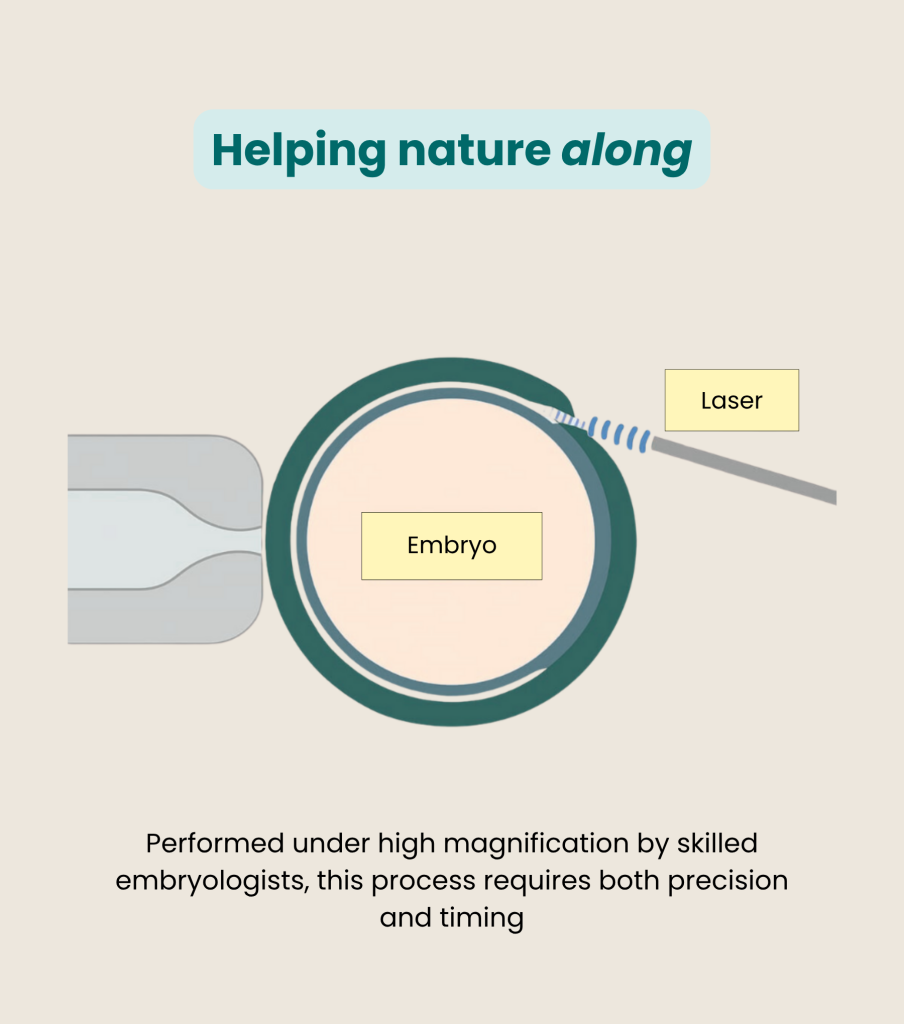
Assisted hatching is an advanced embryology procedure where a tiny opening is made in the outer shell (zona pellucida) of an embryo just before it’s transferred into the uterus. This helps the embryo “hatch” more easily and implant into the uterine lining.
While some embryos hatch naturally, certain patients — especially those with previous failed IVF attempts or older age — may benefit from this technique to improve their chances of pregnancy.
Who is Assisted Hatching for?
Assisted Hatching may be recommended for:
- Women over the age of 35
- Those with previous failed IVF cycles
- Embryos with thick zona pellucida
- Frozen-thawed embryos, which may have a harder outer shell
- Patients with low ovarian reserve or poor embryo quality

The EPIA Difference
Why Choose EPIA for Assisted Hatching?
- Laser-Assisted Precision: We use cutting-edge laser hatching techniques that minimize embryo damage
- Embryologist Expertise: Our team has handled thousands of embryos with sub-micron accuracy
- Improved Implantation Rates: Proven outcomes in patients with implantation failure
- Optimized for Frozen Embryos: Increases success with previously frozen embryos
- Individualized Protocols: Not every embryo needs hatching — we evaluate case-by-case to avoid overuse
Transformation
What is the Assisted Hatching Process?
- Step 1: Embryo Assessment - Our embryologists examine embryos to determine if hatching is needed
- Step 2: Microscopic Laser Hatching - A laser is used to thin or open part of the embryo’s outer shell
- Step 3: Embryo Transfer - The embryo is transferred into the uterus the same day
- Step 4: Monitoring and Support - You’ll have a blood test 10–14 days later to check for pregnancy
Assisted Hatching
FAQs
Can't find what you're looking for?
Is assisted hatching safe?
Yes. It’s done by trained embryologists under strict lab protocols using precision lasers.
Does every embryo need it?
No. We evaluate each case carefully — it’s usually recommended only when clinically justified.
Will it increase my IVF success rate?
It may help in select cases — especially for older women, frozen embryos, or those with failed cycles.
Does it damage the embryo?
When done correctly, there’s minimal risk. At EPIA, we use non-contact lasers for maximal safety.